Showing posts with label Sinusitis. Show all posts

Friday, 17 May 2013

HILANG DERIA BAU (HYPOSMIA)

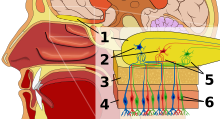
Deria bau adalah salah satu fungsi hidung. Di kawasan langit hidung terdapat saraf-saraf halus (olfactory nerves) yang dapat menghasilkan deria bau. Molekul-molekul bau dari pelbagai punca dapat merangsang saraf-saraf halus tersebut.
Pesakit boleh mengalami masalah kurang deria bau sekiranya hidung sumbat atau kerosakan pada saraf deria bau tersebut. Masalah deria bau terbahagi kepada separa atau kurang deria bau (hyposmia) atau kehilangan seluruh deria bau (anosmia).
Kebanyakan pesakit yang mempunyai masalah deria bau juga mengalami masalah deria rasa. Ia seringkali berkaitan tetapi ada juga pesakit yang mempunyai masalah deria rasa tetapi deria bau adalah normal.

Sistem deria bau (olfaktori) manusia terletak di bahagian atap hidung. 


Punca-punca kurang deria bau

  • Alahan hidung (allergic rhintis)
  • Polip hidung
  • Radang pada sinus (rhinosinusitis)
  • Ketumbuhan atau tumor di dalam rongga hidung
  • Toksin seperti kokain, asap rokok
  • Radang pada saraf deria bau (olfactory nerve) yang disebabkan oleh jangkitan virus, sarcoidosis, Wegener's granulomatosis
  • Masalah endokrin seperti penyakit diabetes/kencing manis, tiroid etc
  • Trauma kepada kepala
  • Proses penuaan
  • Masalah degeneratif seperti Parkinson's disease, Alzheimers
  • Sindrom Kallman


Tuesday, 19 June 2012

SUSAH BERNAFAS SEBAB HIDUNG TERSUMBAT


Hidung tersumbat boleh menyebabkan seseorang merasa sesak nafas, tidur berdengkur, bernafas melalui mulut, suara sengau, sakit kepala, berat kepala, letih dan lesu. Seringkali hidung menjadi tersumbat oleh sebab jangkitan virus atau bakteria semasa demam selsema dan ia akan pulih dalam masa yang singkat. Walaubagaimanapun ada sesetengah pesakit gejala hidung tersumbat ini berlaku pada bila-bila masa atau berpanjangan.

Ruang hidung manusia terbahagi kepada dua; belah kanan dan kiri. Ia dipisahkan oleh tulang tengah iaitu ‘septum’. Masalah hidung tersumbat boleh disebabkan oleh bentuk septum yang bengkok atau bengkakan pada selaput dalam hidung. Selaput hidung boleh menjadi bengkak disebabkan jangkitan kuman, alahan (alergi), polip hidung (nasal polyposis) atau ketumbuhan hidung (tumour). Pada peringkat umur kanak-kanak tisu adenoid yang besar seringkali menjadi punca hidung tersumbat. Terdapat juga insiden di mana bendasing menyebabkan sebelah hidung tersumbat dan berair pada kanak-kanak.

Apa lagi gejala lain berkaitan dengan hidung tersumbat?

Doktor akan bertanya beberapa soalan seperti berikut:
  • Berapa lama masalah ini berlaku?
  • Hidung sebelah mana atau kedua-duanya yang tersumbat?
  • Adakah masalah ini semakin serius dalam jangka masa terdekat?
  • Adakah tuan/puan mengalami sentiasa bersin, hidung gatal, hidung berair?
  • Adakah tuan/puan mengalami masalah sakit kepala, tidur berdengkur?
  • Bagaimana dengan deria bau dan rasa? Adakah ia berkurangan?
  • Pernah mengalami hidung berdarah?
  • Pernah mengalami trauma pada hidung?
  • Adakah tuan/puan menggunakan ubat sembur hidung yang mengandungi pseudoephedrine atau mengambil ubat aspirin?
  • Adakah tuan/puan mengalami masalah kesihatan yang lain seperti lelah, darah tinggi, masalah tiroid etc?

Bagaimana doktor pakar ENT mengenalpasti punca hidung tersumbat?

Setelah mendapat riwayat penyakit dengan teliti, pakar ENT akan memeriksa bahagian ruang hidung dengan menggunakan skop di klinik. Ini membolehkan pakar tersebut melihat dengan lebih jelas ruang dalam hidung dan mengenalpasti punca hidung tersumbat. Selalunya imej skop tersebut disambung kepada kamera dan dipaparkan di atas skrin TV agar pesakit juga dapat melihat dengan sendiri.

Kadangkala doktor akan mengesyorkan pemeriksaan lanjutan seperti ujian darah, ujian alahan atau CT scan. Tetapi ini bergantung kepada setiap kes pesakit dan bukan semua pesakit perlu pemeriksaan lanjutan tersebut.

Rawatan bagi hidung tersumbat

Rawatan hidung tersumbat bergantung kepada puncanya. Sekiranya ia berkaitan demam selsema, rawatan perubatan dapat memulihkan keadaan yang selalunya bersifat sementara.

Rawatan perubatan yang sering disyorkan termasuk ubat sembur hidung (intranasal steroids, nasal decongestant, saline wash/spray) dan pil (antihistamine, decongestant) dalam pelbagai kombinasi. Antibiotik juga perlu sekiranya ada jangkitan bakteria. Ia adalah penting bagi pesakit menggunakan ubat seperti yang disarankan oleh doktor yang merawat. Kadangkala ia mengambil masa beberapa minggu untuk hidung tersumbat menjadi lega.

Sekiranya rawatan perubatan gagal untuk memulihkan masalah hidung sumbat, pakar ENT mungkin mengesyorkan pembedahan (surgeri). Jenis pembedahan bergantung kepada punca masalah hidung tersumbat. Contohnya pembedahan septum (septoplasty) dinasihatkan sekiranya pesakit mengalami tulang septum yang bengkok. Ada juga pembedahan turbinat hidung untuk mengecutkan selaput yang bengkak. Endoscopic sinus surgery pula disyorkan bagi mereka yang bermasalah polip hidung dan sinusitis. Tisu adenoid yang bengkak juga boleh dibedah sekiranya rawatan perubatan gagal. Perlu diingatkan bahawa ada beberapa cara untuk mengatasi masalah hidung tersumbat dan doktor pakar akan menasihatkan rawatan yang paling sesuai bagi setiap pesakit.


Saturday, 9 June 2012

SINUSITIS

Article published in KPJ Klang Specialist Hospital website
Link to article Sinusitis authored by Dr Mazita Ami


Sinuses are air-filled spaces located within the skull bones.  These sinuses are situated behind the forehead, cheek, around the eyes and nasal bones. Sinusitis occurs when there is inflammation of the sinuses due to viral, bacterial or fungal infection.
These sinuses (frontal, maxillary, ethmoid and sphenoid) are usually lined with mucosal membranes and drain into the nasal cavities. The mucous clearance from the sinuses occurs by the sweeping mechanism of small hair like structures called cilia. This ciliary mechanism can be affected by certain medical conditions such as cystic fibrosis and Kartagener’s syndrome. Upper respiratory tract infection, allergies and deviated nasal septum can also cause blockage of the sinuses. Chronic smoking can also affect the ciliary function
and lead to sinusitis.

Symptoms of sinusitis
Sinusitis usually follows a cold that does not improve after 5-7 days. The symptoms include
  • Nasal block
  • Post nasal drip
  • Nasal drip (rhinorrhoea)
  • Headache
  • Cough
  • Bad breath or loss of smell
  • Fever
  • Fatigue
How is sinusitis diagnosed?
The doctor would obtain a complete medical history and ask for the above symptoms.
Nasal endoscopic examination can be performed which enables close inspection of the nasal cavities and the sinus openings. Features of sinusitis would include inflamed turbinates and nasal mucosa with yellowish discharge (mucopus). Presence of nasal polyps would also be inspected.
Computed tomography (CT scan) of the sinuses can further confirm the diagnosis and will show the extent of the sinuses involved. It can also show the anatomy of the sinuses and determine if surgery is necessary. Magnetic resonance imaging (MRI) may also be performed if there is suspicion of tumour or fungal infection.

Treatment
Treatment of sinusitis would be directed at decongesting the nose and treating the infection.
Broad-spectrum antibiotic is prescribed for 10-14 days. Oral decongestants are also given to help open up the blocked sinus openings. Nasal decongestant sprays are also beneficial. However caution is taken that it is not used for more than 3-5 days as it cause worsening of the nasal congestion. Other medications would include analgesics (painkillers), nasal saline sprays and mucolytics. Nasal corticosteroid sprays have also been shown to be beneficial in acute sinusitis, more so in patients with allergies and nasal polyps.

If fungal infection is suspected, treatment is more intensive and often surgery is advised. Invasive fungal infection is life threatening and would require inpatient treatment and immediate sinus surgery.

Is sinusitis a serious condition?
Sinusitis especially when acute can lead to life-threatening complications. Because of the close proximity of the sinuses to important structures, infections can easily spread with devastating effects. The complications include eye infections, eye abscess, blindness, meningitis, brain abscess and encephalitis.
Symptoms of possible complication are swelling or redness around the eyes, headache not relieved with over-the-counter medicine, nausea, vomiting or changes in vision. These symptoms require immediate medical attention.

Does sinusitis require surgical treatment?
Most cases of acute sinusitis would resolve with adequate medications. However patients with nasal polyps, anatomical blockage of sinuses and allergies are prone to get recurrent or chronic sinusitis. This category of patients would often require sinus surgery.

How is sinus surgery performed?
Sinus surgery is performed with the use of nasal endoscopes (Endoscopic sinus surgery). This enables the ENT Surgeon to perform the surgery via the nostrils without any external skin incisions. The surgery is aimed to open the blocked or narrowed sinus openings, correction of deviated nasal septum, removing nasal polyps and drainage of the sinuses.

Nowadays, balloon sinuplasty is also being performed to widen the narrowed or blocked sinus openings. The ENT Surgeon would be able to advise if this type of sinus surgery is suitable for the patient.


Saturday, 28 April 2012

NASAL POLYPOSIS


Nasal polyps are growths or masses in the nasal cavity which is not cancerous. It usually arises due to chronic inflammatory process and will continue to increase in size if not treated. It can even cause distortion in the shape of the nose and eventually bulge out through the nostrils in severe cases.
Nasal polyps usually occur in young and middle aged adults. It is uncommon in children. Nasal polyps are often bilateral (both nasal cavities involved). A unilateral polyp is called an antrochoanal polyp which usually arises from the maxillary sinus and affects teens and young adults.
The cause of nasal polyps is open to much debate but it is agreed that an ongoing inflammatory process is the main pathophysiology. There are however certain associated conditions which increase the risk of developing polyps.
These conditions include asthma which is an inflammatory condition of the airways triggered by allergens, chronic rhinosinusitis which is a chronic infection of the sinuses, aspirin sensitivity, allergic fungal sinusitis which is an allergy to airbone fungi, cystic fibrosis especially suspected in children with nasal polyps (rare disease in Malaysia) and other less common syndromes such as Churg Strauss syndrome, Kartagener’s syndrome and Young’s syndrome. Recent understandings have also shown the relevance of family history and certain genetic predisposition to nasal polyps.

SYMPTOMS
The symptoms or nasal polyps are similar to other inflammatory conditions of the nose such as runny nose, post nasal drip and pressure around the face. However when there is persistence in the symptoms especially when associated with unrelenting nasal block/stuffiness, loss of sense of smell or taste, headache, pain around face and teeth and snoring then possibility of nasal polyposis should be considered.

HOW TO DIAGNOSE NASAL POLYPS?
Diagnosis of nasal polyposis can only be confirmed with an endoscopic examination of the nose. A small rigid or flexible scope is inserted into the nose to fully inspect the nasal cavities. It is a simple procedure performed in the ENT clinic. Polyps appear as grapelike structures protruding into the nasal cavities.
Imaging studies are also performed to see the origin of the polyps and extent of the disease. A computed tomography (CT) or magnetic resonance imaging (MRI) is usually requested. The imaging studies can also reveal possible fungal disease or complications.
Other tests such as allergy test, test for cystic fibrosis or others may be indicated depending on a patient to patient basis.

TREATMENT
The treatment of nasal polyps is long term suiting its nature; underlying chronic ongoing inflammatory process. The aims of treatment are to shrink the size of polyps and prevent complications. Most polyps would respond to medical treatment however some would require surgical intervention.
Medical treatment would consist of topical intranasal steroids, oral corticosteroids, antihistamines and antibiotics in various combinations.
Endoscopic sinus surgery is considered when the polyps do not respond to optimal medical treatment. Surgical intervention is also recommended earlier if patients present with complications. Large nasal polyps often may not shrink considerably with medication alone. However patients have to be aware that nasal polyps do recur after surgery. Therefore adequate followup care and ‘maintenance’ medication is necessary to prevent recurrence.
Monday, 19 March 2012

HOLIDAY BUGS


It’s the school holidays and with the busy jammed packed holiday resorts the children especially can easily catch an infection such as the common cold. Public places are a constant source of germs and we pick them up in playgrounds, supermarket trolley handles, lift buttons, armrests, public transport, swimming pools etc. But bear in mind that it’s pretty normal for a child to have between 6-8 colds a year in the first three years.
The common cold gives rise to symptoms of nasal congestion, runny nose, sore throat and fever. It is caused by the adenovirus and coronavirus and usually runs a self limiting course.  These symptoms last between seven to ten days. Therefore patients rarely need antibiotics unless there is superadded bacterial infection. Treatment of the common cold is symptomatic ie paracetamol/brufen for the fever, oral decongestant/nasal decongestant spray for the blocked nose, cough syrup etc. Hence why a nice bowl of hot chicken soup makes the patient feels better. Symptomatic treatment only helps to ease the symptoms but it’s the patient’s immune system that will continue working against the infection. 

When do we need antibiotics?
Antibiotics are prescribed when there is superadded bacterial infection. Usually this occurs when there’s complication due to spread of the infection.
  • Sinusitis- Patients will have badly congested nose, post nasal drip, yellow to greenish phlegm, headache, facial pain/fullness.
  • Otitis media- Patients will complain of pain in the ear with high grade fever. The ear feels blocked and may have ear discharge.
  • Throat infection such as tonsillitis or severe laryngopharyngitis- This is commonly due to the postnasal drip. In common cold, initial throat discomfort caused by the viral infection is common. However if the sore throat becomes severe and there is pain on swallowing, most likely there is superadded bacterial infection such as Streptococcus.
  • Lung infection such as bronchitis or pneumonia- Patients will present with productive cough, shortness of breath and fever. 

Best remedy- prevention, prevention & prevention
Good hygiene can reduce the exposure and risk of catching a cold. However bear in mind that ‘too much’ hygiene or ‘living in a bubble’ is also not advisable because exposure to some germs are needed to mature and strengthen the immune system. So moderation is the key. (Look up articles on hygiene hypothesis)
  1. Proper hand hygiene and handwashing technique
  2. Avoid close contact with anyone having a cold and do not share utensils
  3. Best to use tissues that can be disposed after use         
  4. Keep the house/bedrooms well ventilated
  5. Boost your immune system- many good habits such as taking supplements, adequate sleep, regular exercise, reduce stress and avoid smoking. There are many articles written on this topic and I leave it to individuals to find what’s best for them. I find this article apt at summarizing this topic Strengthen your immune system 


Wednesday, 29 February 2012

MENGATASI MASALAH ALAHAN (RESDUNG)

Masalah resdung seringkali berkaitan dengan gatal hidung, bersin, hingus cair dan hidung sumbat. Dalam bahasa perubatan ia lebih sesuai dipanggil sebagai ‘Allergic Rhinitis’ atau alahan hidung. Pesakit juga boleh mengalami simptom gatal pada bahagian mata dan kulit muka. Gejala ini berlaku kerana pesakit alah kepada pelbagai bahan terutamanya hama, makanan laut, belacan dan sebagainya.

Perkara utama dalam menangani masalah alahan hidung adalah untuk mengelak dari bahan yang menyebabkan alahan atau ‘alergen’. Salah satu cara untuk mengenalpasti alergen adalah dengan mencatatkan dalam diari makanan yang diambil setiap hari dan juga keadaan persekitaran. Seringkali apabila diimbas kembali pesakit mungkin dapat meneka alahan mereka dengan tepat.

Selain daripada usaha pencegahan, para doktor mungkin mengesyorkan pengambilan ubat anti-alahan hidung samada dalam bentuk pil antihistamin atau pam/spray hidung. Ubat ini dapat membantu mengawal simptom alahan hidung dengan lebih berkesan, terutamanya bagi pesakit yang mengalami alahan yang teruk atau yang terpaksa terdedah kepada alergen seperti mereka yang bekerja di gudang yang berhabuk.

Langkah- langkah mengatasi alahan

Elak dari terdedah kepada alergen
Pengambilan ubat yang disyorkan doktor apabila mengalami kes alahan teruk


Mengatasi masalah alergen utama iaitu HAMA
Ramai pesakit alahan hidung mempunyai alahan terhadap hama. Hama adalah binatang yang hanya dapat dilihat melalui kanta mikroskop. Sebenarnya alahan itu adalah terhadap najis hama tersebut. Hama hidup dengan memakan sel kulit mati yang terdapat pada katil dan perabot di dalam rumah kita. Ia suka kepada keadaan yang panas dan lembab.


Selain dari alahan hidung, alahan kepada hama juga boleh menyebabkan sakit asma (lelah) atau gatal kulit (eczema). Ciri utama dalam mengatasi alahan hama adalah pencegahan dan kebersihan.

Cara mengatasi hama
  1. Elak penggunaan permaidani di dalam rumah terutamanya di bilik tidur
  2. Elak mengunakan terlalu banyak kusyen atau perhiasan rumah yang dapat mengumpul habuk
  3. Alat mainan seperti patung beruang seharusnya jenis yang boleh dibasuh dengan senang dan kerap
  4. Basuh cadar dan selimut sekurang-kurangnya dua kali seminggu
  5. Elok basuh cadar dan selimut dengan menggunakan air panas 600C
  6. Menggunakan hampagas untuk mengurangkan habuk. Penggunaan hampagas yang mempunyai filter yang bagus (high efficiency filter, HEPA) dapat mengurangkan habuk dan hama dengan berkesan
  7. Mengelap perabot dengan kain lembap lebih berkesan dari menggunakan bulu ayam/plastik
  8. Memakai 'face mask' terutamanya semasa mengemas rumah ataupun di tempat kerja yang berhabuk
  9. Mengelakkan haiwan peliharaan seperti kucing atau anjing dari kawasan bilik tidur
  10. Penggunaan lapik katil dan bantal yang anti-hama (anti-dust mite covers) juga dapat membantu

Apa yang boleh berlaku sekiranya masalah alahan hidung (resdung) tidak dikawal?
  • Boleh menyebabkan masalah infeksi atau jangkitan kuman pada rongga hidung dan sinus (sinusitis)
  • Boleh menyebabkan masalah polip hidung
  • Gejala hidung yang sentiasa sumbat boleh mengurangkan daya konsentrasi dan menyebabkan pesakit merasa lesu
  • Hidung tersumbat boleh mengganggu tidur yang berkualiti
  • Alahan hidung juga berkait rapat dengan penyakit asma/lelah yang sukar dikawal
  • Alahan hidung juga boleh menyebabkan pesakit mengalami masalah jangkitan telinga ‘otitis media’ terutamanya pada kanak-kanak

Monday, 30 January 2012

CARE AFTER ENDOSCOPIC SINUS SURGERY


Endoscopic sinus surgery is a procedure that is performed to open up blocked sinuses. It entails using scopes which provide good visualization of the nasal cavity structures without having to make any external skin incisions. Compared to yesteryears of open sinus surgery, endoscopic sinus surgery allows shorter hospital stay and faster recovery.
Endoscopic sinus surgery is recommended when there is failure of medical therapy in treatment of sinus infections.  It is also performed when there are polyps or tumours within the nasal cavity. Correction of deviated nasal septum causing nasal blockage can also be performed by endoscopy.

What to expect when you wake up from the surgery?
Usually the nose will be blocked with nasal packing and a gauze dressing is placed at the front of the nostril to absorb any blood stained discharge and changed whenever soaked. There are two types of nasal packing; dissolvable and non-dissolvable. The non-dissolvable nasal packing which looks like nasal tampon is usually removed 24-48 hours after the operation. The dissolvable nasal packing is left in place and will dissolve within few days.  Patients may have to breathe through their mouth because of the nasal pack.

Patients will experience some pain over the nose area and mild headache is expected. Analgesics are prescribed for pain relief. Inform the surgeon if you still experience considerable pain.

Once the nasal pack is removed, the patient is advised to pinch the nose for at least 15 minutes to stop the bleeding. The patient is also propped up in a sitting forward position and a kidney dish/basin is placed in front so that the patient can spit out any blood discharge trickling at the back of the throat.
The patient is then observed for any serious bleeding before allowed home. A small amount of blood stained discharge is expected for the next few days.

Post op advice for patients
  • When lying in bed, keep the head elevated to reduce bleeding from the operated site.
  • Patients should not blow their nose for 1 week after surgery. When they sneeze, make sure the mouth is open to reduce pressure in the nasal cavity and prevent bleeding.
  • Nasal douching will be prescribed by the surgeon using pre-prepared salts which are dissolved into cooled boiled water. Patients are expected to perform the douching twice a day until healing is complete. The nasal douching will prevent dry crusting in the nasal cavity and allows easy dislodgment of blood clots.
  • Patients should also avoid straining, heavy lifting, swimming and flying for a few weeks.
  • Patients should avoid allergies and any food known to cause an allergic reaction. Reduce intake of dairy products which can increase mucous production. Refrain from smoking and exposure to secondhand smoke. Patients should also avoid crowded places in case they may catch an infection.
  • Patients must comply with the medications prescribed by the surgeon which often includes antibiotics.
  • Patients are required to come for follow-up at 5-7 days post operation. During the follow-up visits, the surgeon will monitor the recovery process by endoscopic examination in the clinic and suction removal of blood clots or secretions will be performed.
What next?
The recovery period can take between 2-4 weeks. Patients are often given at least 1 week home rest after the operation. The recovery process varies from patient to patient.
Some patients require long term medication after the endoscopic sinus surgery to prevent recurrence of the disease such as polyps.
Follow up is necessary until the recovery is complete and in patients with polyps they may still need a 6-12 monthly checkup to monitor for recurrence.